Evidence & proof
Burden of proof
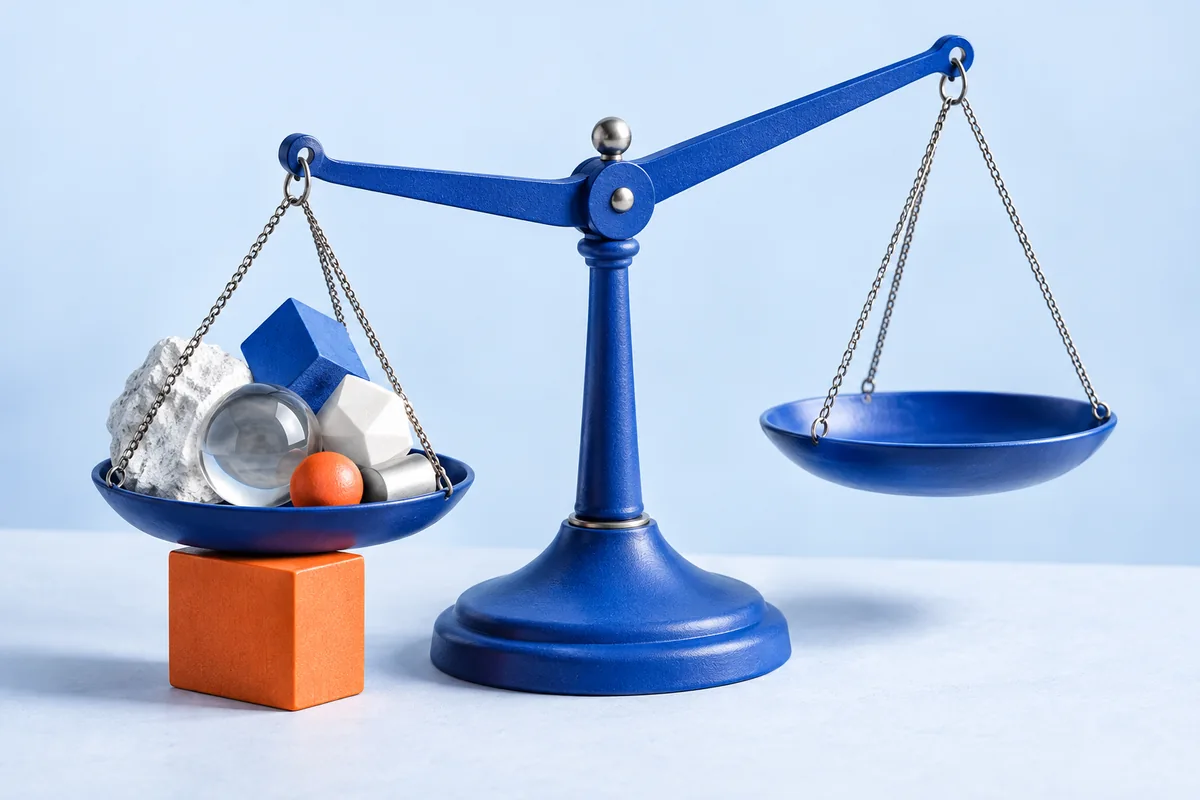
The burden of proof is the obligation to supply evidence for a claim, and it rests with the person making the claim, not with the person who declines to accept it. The rule is not a courtesy or a debating convention. It follows from an asymmetry in the world: a positive claim points at something that either exists or does not, and whoever asserts it is the only party in the conversation who can go and look. There is also a legal sense of the phrase, with formal standards such as preponderance of the evidence, and that is a matter of courtroom procedure. This page is about the epistemic burden, and it takes up the legal standards only far enough to show why importing them into ordinary reasoning goes wrong.
Why the burden sits with whoever makes the claim
The burden sits with the claimant for 3 reasons, and each of them is practical rather than moral.
- Access. The person asserting that something exists knows what convinced them and can produce it. The person doubting it has nothing to produce.
- Asymmetry of search. Confirming an existence claim requires finding one instance. Refuting it requires searching everywhere and reporting nothing, which is a task with no natural end.
- Default cost. A discussion in which every unsupported assertion had to be actively disproved would have room for nothing else, because assertions are cheap to make and expensive to check.
Take a neutral case. Someone says the coin in their pocket is a rare minting error worth more than its face value. The burden is theirs, and it is discharged cheaply: they take the coin out. It would be strange to insist that anyone who doubts it must first survey the national mint's records to prove no such error was ever struck. The claim is one hand movement from being settled by whoever raised it, and that is exactly the structure the rule is tracking. Which side has to move is decided by which side has the evidence within reach.
Notice what the rule does not say. It does not say the claim is false, and it does not say the doubter is right. An unsupported claim is unsupported, which is a statement about the state of the evidence, not about the state of the world. Treating failure to meet the burden as a demonstration of the opposite is its own error, sometimes called the appeal to ignorance.
Is the burden of proof a fallacy
No. The burden of proof is a rule about who owes evidence, and a rule cannot be a fallacy. The fallacy that goes by this name is shifting the burden of proof, which is the move of demanding that an opponent disprove a claim instead of supporting it yourself. Search results conflate the two constantly, and the confusion matters, because someone who has learned that the burden of proof is a logical fallacy will end up treating a legitimate request for evidence as a foul.
The shifted version has a recognizable grammar. Watch for these sentences:
- Prove it did not happen.
- Can you show me one study that rules it out?
- Until someone explains it better, my explanation stands.
- Nobody has ever disproved this.
Each of them takes an unsupported assertion and reassigns the work of testing it to the audience. The repair is a single sentence and it is not aggressive: ask what evidence led the speaker to the claim, then evaluate that. If the answer is that no evidence led to it and no evidence counts against it, the conversation has finished without anyone having to lose it.
The relatives it travels with
Shifting the burden rarely appears alone. It commonly follows the straw man fallacy, because misdescribing the other side's position as a strong denial makes it easier to demand proof of that denial. It also pairs with moving the goalposts, in which the evidence is supplied, found sufficient, and then quietly declared insufficient by a newly raised standard. The tell for that pairing is a request for evidence that never states in advance what evidence would be enough.
Extraordinary claims and the sliding scale
Extraordinary claims sit at the top of a sliding scale, because the size of the burden is not fixed: it rises with how much the claim would overturn if it were true. Pierre-Simon Laplace put the principle in his 1814 essay on probabilities, arguing that the weight of the evidence for an extraordinary claim has to be proportioned to its strangeness. This is not a licence to dismiss unfamiliar claims. It is a statement about how much of the existing record a new claim would force you to rewrite, and therefore about how much new record it has to bring.
A claim that a colleague cycled to work today needs almost nothing, because it fits everything already known. A claim that they cycled from another continent overnight needs a great deal, because accepting it means discarding well tested facts about distance and time. The evidence required is not larger because the claim is unwelcome. It is larger because more established results are standing in its way, and they were not established for nothing. This is where Occam's razor enters: when a modest explanation and a spectacular one both fit the same observations, the razor breaks the tie in favor of the one demanding fewer new entities, and the spectacular explanation has to earn its extra machinery with evidence that the modest one cannot account for.
Burden of proof, burden of evidence, and preponderance of evidence
3 phrases circulate together and mean 3 different things, and separating them removes most of the confusion in an argument about who has to do what.
| Phrase | What it refers to | Where it applies |
|---|---|---|
| Burden of proof | Who is obliged to support the claim | Any discussion in which a claim has been made |
| Burden of evidence | How much has to be produced before the discussion moves on | The same discussion, once the first burden is accepted |
| Preponderance of the evidence | A fixed threshold, more likely than not | A formal legal setting, not general reasoning |
The third row is the one to keep out of ordinary argument. Legal standards exist because a court has to reach a decision on a schedule, with the parties present, and stop. Inquiry has no such deadline, so it uses no fixed threshold at all: the standard rises with the claim, and the correct verdict is often that the evidence is not yet enough for anyone to conclude anything. Importing a legal threshold into an epistemic dispute produces the odd result that a claim can be more likely than not and still be a poor thing to believe, which is exactly what the sliding scale is designed to capture. What counts as evidence in the first place is a prior question, and the standards that answer it do not change according to who is asking.
The test to run when someone hands you a claim
Run 4 questions, in order, and notice which one the conversation stalls at.
- Identify the assertion. What exactly is being claimed, stated so that it could turn out false?
- Ask who is asserting it. Who is making the positive claim here, and am I being asked to disprove something instead of being shown something?
- Request the threshold in advance. What evidence would you accept as settling this, and has that standard been named before the evidence arrives?
- Weigh the strangeness. How much of what is already well established would have to be wrong for this to be true?
The third question is the useful one, because it is answerable by both sides and it exposes an unfalsifiable position without anyone having to accuse anyone of anything. The honest limit is worth stating too: the burden of proof settles who has to speak next, not who is right. A claim can be badly argued, poorly supported and true, and the person who dismisses it on procedure alone has not learned anything about the world, only about the argument. Epistemology is the wider subject that asks what would count as knowing either way.
Where to go next
A better question is a good next step.
Put it into practice